
Unified Interventional Program Improves Outcomes for Early-Stage Lung Cancer
January 6, 2026
Pulmonary and thoracic teams are united in a single service line, setting a new national standard for lung cancer care excellence.
When a patient has a heart attack or stroke, care begins without delay because every lost minute means lost tissue. Yet early-stage lung cancer has rarely been treated with the same urgency, even though evidence shows that prompt intervention leads to better outcomes.
For reasons that range from clinical silos and technology limitations to socioeconomic barriers, patients must often wait several weeks between diagnosis and treatment initiation. In some, that timeline allows the progression of cancer that, in turn, decreases the chances of cure.
Prioritizing early-stage lung cancer care is crucial to improving patient outcomes. At the Harold C. Simmons Comprehensive Cancer Center, a cross-departmental provider team is making this goal a reality.
As the only National Cancer Institute-designated Comprehensive Cancer Center in North Texas, UT Southwestern has built a unique program that could set a new national standard for excellence in lung cancer care.
The Interventional Pulmonology and Thoracic Surgery teams are united in a single service line, minimizing the time-to-treatment window from months to two weeks — and, in some cases, as little as 24 hours. Pillars of the program include optimized patient care pathways, research-led technology, and streamlined referral processes.
With one of five Special Programs of Research Excellence (SPOREs) in lung cancer grants in the nation, the team is uniquely positioned to lead this paradigm shift. Plus, UT Southwestern is recognized by U.S. News & World Report as a top 25 hospital for cardiology, heart, and vascular surgery and a top 20 hospital for cancer, as well as pulmonology and lung surgery.
Inderpal S. Sarkaria, M.D., M.B.A., FACS, Professor of Cardiovascular and Thoracic Surgery and Chief of the Division of Thoracic Surgery at UT Southwestern, says this unique program builds upon the institution’s renowned engines of research and discovery.
“The only way to benefit from collective expertise is to bring the experts together,” Dr. Sarkaria says. “Here, interventional pulmonary and thoracic surgery work in tandem as proceduralists for cancer and many other pulmonary conditions.”

Optimized Patient Care Pathways
One of the program’s priorities is to minimize the diagnosis-to-treatment timeline. The group’s unique patient care pathways allow for faster triage and more efficient care from the first touchpoint with the program. For example, nurse navigators prescreen patients to expedite care for people with a high suspicion of cancer and assess who may be a good candidate for surgery.
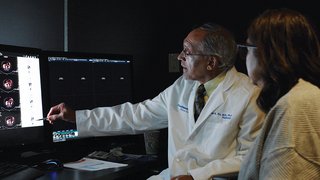
Co-localized interventional pulmonologists and thoracic surgeons see patients together for new lung nodules. Together, the specialists determine whether a robot-assisted biopsy or other testing is needed and streamline the process to omit system bottlenecks.
UT Southwestern is also investing in side-by-side, first-in-class procedure and operating rooms at William P. Clements Jr. University Hospital in Dallas. Eligible patients will be able to get a biopsy and surgery under a single anesthetic.
“If prescreening indicates the patient is a good surgical candidate, for example, we ask them to come to their first visit without eating or drinking,” Dr. Sarkaria says. “We can remove their cancer that day instead of delaying care and prolonging their stress.”
Research-Led Technology
UT Southwestern participates in groundbreaking clinical trials, which have empowered the shift to predominantly robotic-assisted, minimally invasive procedures when appropriate. When these treatments are paired with advanced imaging and agents to track occult disease, patients benefit significantly.
“Our objective in introducing new technologies is always to set up patients for longer, higher-quality lives,” Dr. Sarkaria says. “We work in parallel with technology companies to perfect the visibility and flexibility of tools that help us make more patients cancer-free.”
Some of the latest developments for early-stage lung cancer treatment:
- Single-port robots: Complex lung cancer surgeries are now performed through a single incision using robots equipped with video-assisted thoracic surgery (VAT).
- Advanced imaging: Virtual lung segmentation allows surgeons to precisely locate tumors and plan more precise surgeries.
- Intraoperative molecular imaging: Agents that glow under special lighting can help surgeons identify occult disease. For example:
- Pafolacianine: This folate receptor antibody attaches to a fluorophore in cancer cells. Its use identifies surgical margins with better precision and improves surgical outcomes from 29% to 53% of cases.
- Endobronchial “hurricane” coil: Implanted near the lung lesion, the device spotlights cancer cells for the surgeon to remove via a small wedge resection, minimizing the need for a large resection while still eliminating the cancer.
- Indocyanine green: This near-infrared fluorescent dye can improve image-guided surgery outcomes by spotlighting tumors, affected lymph nodes, and adjacent normal tissues.
Streamlined Referral Processes
Several minimally invasive surgical technologies are advanced in lung cancer. However, offering the best of these is inconsequential if patients cannot get in to see a specialist, Dr. Sarkaria says. Therefore, UT Southwestern has simplified its lung cancer referral pathways to give more patients and providers access to advanced lung cancer care. Referring physicians can call 214-645-7700 to make a referral, and a nurse navigator will return the call the same day.
With optimized patient care pathways and a streamlined referral process, more patients can access UT Southwestern’s multidisciplinary lung cancer expertise and advanced surgical technology. As this innovative care model takes hold, more patients will get the chance for longer, healthier lives after a lung cancer diagnosis.

About the Expert
Inderpal S. Sarkaria, M.D., M.B.A., FACS
Professor, Cardiovascular and Thoracic Surgery Chief, Division of Thoracic Surgery
Robert Tucker Hayes Foundation Distinguished Chair in Cardiothoracic Surgery
Member, Experimental Therapeutics Research Program, Harold C. Simmons Comprehensive Cancer Center