NF2-related schwannomatosis: Supporting patients with rare hearing nerve tumors
November 18, 2025


In their early 20s, most people are living in the moment, not worrying about their future health or livelihood. Almost certainly, the thought of developing a terminal disease never crosses our minds at that age.
But that is the reality for the approximately 1 in 25,000 people worldwide who live with NF2-related schwannomatosis (NF2-SWN), formerly known as neurofibromatosis type 2. This rare genetic disorder causes vestibular schwannomas – tumors that grow on the hearing nerves in one or both ears – in addition to a variety of other tumors throughout the nervous system.
While not cancerous, vestibular schwannomas cause disruptive symptoms such as hearing loss, poor balance, ringing in the ears, and facial paralysis. Unfortunately, the disease is both incurable and progressive, with patients at risk of developing new or recurrent tumors throughout their lives.
Though symptoms can arise in childhood, most people with NF2-SWN are diagnosed in their teens or early 20s. Each of their children has a 50% chance of inheriting the disorder, which shortens the lifespan due to its heavy tumor burden on the nervous system.
Despite the severity of the disorder, there is a robust community of families, researchers, and NF2-SWN specialists with a passion for improving patients’ quality of life and finding new and better therapies. UT Southwestern, designated as a Comprehensive Schwannomatosis Center by the National Patient Network and the Children’s Tumor Foundation, is one of 27 comprehensive NF2-SWN centers in the U.S. and the only site in Texas for the Neurofibromatosis Clinical Trials Consortium.
Though there is not yet a cure for NF2-SWN, our specialists help patients manage their tumors and associated symptoms throughout their lives, giving families compassionate care, hope, and knowledge. We’ve seen patients with the disorder accomplish amazing things, from attending college and launching careers to raising families and becoming advocates for NF2-SWN research.
Each person’s symptoms, severity, and outcomes are different, and, unlike more common disorders, there are no firm guidelines for treatment. Without an experienced care team, certain surgeries, procedures, or medications may bring about more harm than benefit.
Receiving safe, beneficial care requires a team of specialists who deeply understand the disorder, its symptoms, and the downstream effects of treatment decisions.
What is NF2-SWN?
Humans begin life as a single cell, which copies its DNA and divides into multiple cells. If, in that process, a random copying error occurs, that is called a genetic variance. If the error occurs in the NF2 gene, which helps create a protein called schwannomin (or merlin) in the nervous system, it can cause NF2-SWN.
NF2-SWN is an autosomal dominant disorder – meaning it is a genetic condition passed down in families – yet about half of patients are the first in their family. The average age of symptom onset is 18-24 years, though it can start in childhood for some.
NF2-SWN is an autosomal dominant disorder, meaning it is a genetic condition passed down in families, yet about half of patients are the first in their family. It does not skip generations, and there is a 50/50 chance each child born to a parent with the disorder may inherit it.
The average age of symptom onset is 18-24 years, though it can start in childhood for some. By the time many NF2-SWN patients are diagnosed they may have already had their own children, which compounds the emotional impact of diagnosis.
NF2-SWN is a never-silent condition, meaning all patients who have it will develop symptoms. The hallmark presentation is bilateral vestibular schwannomas (tumors in both ears), which typically develop by age 30. The tumors grow on the vestibular nerve; tumors also can grow elsewhere in the nervous system.
Symptoms of NF2-SWN worsen over time and may include:
- Partial or total hearing loss
- Challenges with balance
- Difficulty walking
- Ringing in the ears
- Facial paralysis
- Blurred vision or vision loss
- Weakness, tingling, or numbness in the hands or feet
NF2-SWN tumors can be successfully treated with surgery or medication, but frequently they return, and most people with the condition will die from its cumulative toll on the body and nervous system.
How is NF2-SWN diagnosed?
Having bilateral vestibular schwannomas is enough to diagnose some patients. For those with a single ear tumor (vestibular schwannoma) or tumors elsewhere, we may recommend genetic testing.
Blood-based genetic testing without a biopsy may, in some cases, confirm the diagnosis of NF2-SWN, but often this is not confirmatory. If tumors are removed due to symptoms, testing tumor tissue can increase the likelihood of a genetic diagnosis. Even for patients in whom clinical features confirm the diagnosis of NF2-SWN, genetic testing may still add value, as specialists may be able to use it to predict disease severity and may provide a foundation for a patient’s life decisions, such as family planning.
Unfortunately, because blood-based genetic testing does not always confirm an NF2-SWN diagnosis, and because not everyone needs tumor surgery from which tissue becomes available, the journey to receiving a final diagnosis can sometimes take years. In these cases, we may still treat patients based on a suspicion of NF2-SWN to help manage symptoms and preserve their hearing.
Living with hope and endurance

When Connor O’Brien of Garland, Texas, was about 18 months old, his right eye began to turn outward when he looked into the distance. His doctors found a pediatric cataract, and during surgery to remove it, they noticed swelling of his optic nerve.
A neurologist discovered that Connor’s cerebral spinal fluid pressure was very high, and he began to have frequent vomiting. For the next two-and-a-half years, Connor would have regular MRIs and lumbar punctures to relieve the pressure, but his family was left without a diagnosis.
At age 4, a tumor appeared on Connor’s frontal lobe. He became a patient of Robert N. Hogan, M.D., Ph.D., and Daniel Bowers, M.D., UT Southwestern physicians who treat patients at Children’s Health, and the family finally started getting answers.
“Progress toward a diagnosis didn’t really happen until he began seeing doctors at Children’s Health,” said Tammy Benson-O’Brien, Connor’s mother. “The doctors being in contact and having easy access to each other’s notes allowed for a comprehensive type of care for Connor.”
Within 24 hours of the tumor’s detection, Connor had brain surgery to remove it, confirm the type of tumor, and obtain genetic testing. Six weeks later, he was diagnosed with NF2-SWN caused by a spontaneous genetic alteration that occurred during his development in the womb.
While his family was glad to have a diagnosis, it was daunting. When they learned there was no cure, Tammy turned to advocacy.
“Becoming a part of the Texas NF Foundation saved us,” she said. “We met other NF families and saw how they lived with hope and endurance.”
Through the foundation and an NF2 Facebook group, the O’Brien family has shared in peer support, health education, heartbreaks, and celebration with families around the U.S. Tammy travels to Washington, D.C., each year to advocate for government research funding for neurofibromatosis and schwannomatosis, and the O’Brien family attends the Texas NF Foundation family camp, support group, and other annual events.
Connor, now 22, enjoys making and listening to music, as well as coding, reading, and taking walks. He has a passion for ministry and spends much of his time spreading the gospel through online formats, including his own website. He encourages others with NF2-SWN to trust the process with their medical conditions and never give up.
Tammy said it’s important to work with a comprehensive care team that specializes in NF2-SWN. Most importantly, she encourages families to ask a lot of questions and be active participants in the care of their loved one.
How is NF2-SWN treated?
Because the disorder presents in such varied ways, each patient needs a personalized care plan that integrates specialists who understand the short- and long-term implications of the symptoms and treatments.
Timing is everything with NF2-SWN. Waiting too long to start medication or perform surgery can result in lost function. But acting too quickly can introduce challenges later in life. As with diagnosis, treatment options require a balance of risk and benefit customized for each patient.
In general, treatment should begin when the patient experiences persistent change that impacts his or her life. The care plan must remain agile, involving new specialists and options as symptoms change and the disease progresses.
UT Southwestern holds regular tumor board meetings in which we gather specialists – neurologists, neurosurgeons, neuro-oncologists, otolaryngologists, and otologists – to discuss treatment options and help patients avoid unnecessary surgeries or medications. Instead, we focus on advanced treatments that can help preserve function and extend quality of life.

Which medications can make a difference?
Chemotherapies can help slow the growth of tumors and/or preserve as much hearing as possible in most people with NF2-SWN. However, once a patient loses hearing, medication is ineffective. While there are several medications used with NF2-SWN, the most commonly used today include:
- Bevacizmab may shrink some types of tumors and may also improve hearing for some patients. It is given by IV infusion every two to three weeks.
- Brigatinib, an oral medication, may stabilize or shrink a variety of tumor types including schwannomas and meningiomas.
While effective, these medications are not curative and can cause side effects such as abdominal pain, fatigue, high blood pressure, infertility in women, inflammation, muscle tenderness, nausea, nosebleeds, and vision changes, as well as increased risk of blood clots, breathing problems, heart attack, or stroke. Patients and doctors should keep an open line of communication to maximize benefits and minimize side effects of these chemotherapies.
Appointments
To talk with an expert about NF2-SWN care, make an appointment by calling 214-645-8898 or request an appointment online.
How can surgery help?
If a large tumor is pressing on the brain stem, spine, or other critical structures, surgery may be beneficial. However, about two-thirds of newly diagnosed vestibular schwannomas do not need immediate surgery and can be monitored with imaging.
Surgery to remove vestibular schwannomas can result in facial nerve injury, cerebrospinal fluid leakage, vascular injuries, or infections such as meningitis. It can also cause hearing loss due to damage of the cochlear nerve, which supports auditory processing between the ear and the brain. Overall, surgery tends to be used for patients who are having compression of vital structures or have lost functional hearing due to a tumor.
In some instances, a tumor may only be partially removed so that the cochlear nerve can remain in place. In such situations where the nerve remains and a cochlear implant is surgically placed, some amount of hearing may be restored and about half of patients may be able to understand speech after surgery. This has become an excellent option to help people with NF2-SWN maintain hearing as long as possible.
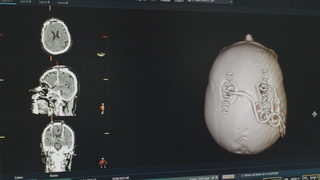
The auditory brainstem implant (ABI) is another potential intervention to help people with NF2-SWN maintain some hearing. It uses a tiny paddle to directly stimulate the cochlear nucleus, the area in the brainstem where sound is first relayed to the brain. The nucleus holds many types of neurons that respond differently to sound, and the ABI paddle uses an electrode array to activate them to receive and interpret sound.
Up to half of patients achieve partial restoration of sound awareness with an ABI, and lipreading can augment their speech comprehension. UT Southwestern is among the few centers in Texas that perform the cochlear implants and ABI procedures.
In some cases, patients who have had tumor removal surgery develop facial weakness, such as difficulty closing an eye, which can lead to eye dryness and vision problems. We partner with UT Southwestern ophthalmologists and facial plastic surgery experts including Shai M. Rozen, M.D., to manage facial paralysis and help patients achieve better function and a more natural appearance.
What are the benefits of speech-language therapy?
As NF2-SWN progresses, some patients may have difficulty making consonant sounds, slurring speech, controlling their volume, maintaining a natural rise and fall in their vocal tone, and swallowing. Speech-language therapy can help patients strengthen surrounding muscles and tissues to support swallowing and change how sound is produced.

Where to find peer and family support
For those living with NF2-SWN, the importance of community and support cannot be understated. Patient advocacy groups in Texas and across the nation provide hope and helpful strategies.
UT Southwestern hosts a patient education event each year for people with NF2-SWN and other auditory tumor conditions.
We are also involved with the American Acoustic Neuroma Association, a national patient education and support organization. More resources for patients and families include:
- Texas Neurofibromatosis Foundation provides support, education, advocacy, and funding for research. In collaboration with the Texas Neurofibromatosis Foundation, the UTSW/Children’s NF program hosts an annual education symposium for patients and families.
- Children’s Tumor Foundation is committed to ending neurofibromatosis and schwannomatosis through research. This national organization is focused on patient education and support as well as research to help treat NF and SWN.
- REiNS Collaboration is an international group working to standardize criteria for understanding treatment response in patients with neurofibromatosis and schwannomatosis.
- NF Young Adult Leadership Program is a networking event where teens and young adults can develop leadership skills and advocate for NF and SWN research.
For people living with this rare genetic disorder, change is a constant. But you are not alone. With support from the NF2-SWN community and a specialist team that understands the nuances of diagnosis and treatment, you can feel confident in your care and enhance your quality of life.
To talk with an expert about NF2-SWN care, make an appointment by calling 214-645-8898 or request an appointment online.