‘My voice was gone’: Understanding and treating phonotraumatic voice disorders
August 27, 2026

"I feel like singing is my voice … my true expression of everything that I am."
"Singing makes me whole … If I'm not singing, if I'm not doing music, I don't feel complete."

Many musicians and performers can relate to these sentiments, which were gathered from participants in a recent study I conducted with Carolyn Smith-Morris, Ph.D., Interim Chair of the Department of Social and Behavioral Sciences in the Peter O’Donnell Jr. School of Public Health at UT Southwestern, and Ella Dabney, B.A., B.S., a professional singer, former researcher at UT Southwestern, graduate of Southern Methodist University, and a physician assistant student at The University of Texas Medical Branch.
In the study, we spoke with vocal professionals – such as singers, actors, lawyers, and teachers – who had lived with a voice disorder caused by phonotrauma. The condition causes swelling of the vocal cords (clinically referred to as vocal folds) and growth of lesions that can change the sound and the feel of the voice, which can take a significant toll on mental health and self-esteem.
Before I became a voice-specialized speech-language pathologist and voice researcher, I trained as an opera singer. I understand the physical and emotional complexities of vocal training and performance. Developing phonotraumatic voice disorders can turn your world upside down, threatening your career, your livelihood, and your sense of self-worth as you navigate these conditions.
Stigmas, both real and perceived, can cause vocal professionals to try pushing through their symptoms rather than receiving proper treatment – a path that usually leads to worsened symptoms. As one of our study participants described it, “My voice was gone because it just couldn’t take that much pressure.”
Fortunately, there are effective prevention steps and treatments for phonotraumatic voice disorders that can help you literally and figuratively get your voice back.
Laura Toles, Ph.D., Assistant Professor of Otolaryngology at UT Southwestern, talks about those at risk of phonotraumatic voice disorders and how voice therapy can help people manage their vocal load.
What causes phonotraumatic voice disorders?
About one in 13 U.S. adults develops voice problems each year. Phonotraumatic voice disorders are considered one of the more common causes of such problems, especially among people with heavy voice demands.
When we talk or sing, our vocal cords vibrate rapidly against each other to produce sound. Among adult women, for example, the vocal cords typically vibrate about 200 times per second while speaking. Singing means faster vibrations – an adult female singer's vocal cords may vibrate more than 1,000 times per second when singing high pitches.
With this motion comes a great deal of heat and friction, which can cause wear and tear. For people who speak or sing for long periods of time, especially at a loud volume, this can cause:
- Vocal polyps: Soft, often blister-like growths that develop on one or both vocal cords and can vary in size, shape, and appearance.
- Vocal nodules: Swollen, stiff callus-like masses that form on the vocal cords.

All these conditions can impede the vibration of the vocal cords, leading to phonotraumatic voice disorders. Physical symptoms can include:
- Hoarse, scratchy, or raspy voice
- Limited vocal range or register changes
- Sore or tender throat
- “Tired” voice, also known as vocal fatigue
- Increased effort to produce sound
People who rely on their voices most often are the ones who develop phonotraumatic voice disorders. This can be true for professional singers, teachers, faith leaders, coaches, fitness instructors, and even people who are extroverted by nature. It can be difficult to properly rehabilitate the voice without difficult tradeoffs in their personal and professional lives, leading to emotional distress.
“The emotional, psychological, and contextual experiences of phonotrauma have been under-researched,” Dr. Smith-Morris said. “By looking at data and talking with people, we discovered that there is a broad range of fairly serious, significant emotional impacts of vocal trauma and even some associated with entering and completing vocal therapy.”
How can phonotraumatic voice disorders affect mental health?
Through our research, one theme became clear: Those who were afflicted by phonotrauma felt like their voice was part of their identity.
Phonotraumatic voice disorders are not just a physical condition. They affect people on a deep, intimate level. As a result, someone who uses their voice for a living may initially react to the diagnosis with denial. They may ignore early symptoms or try to find convenient explanations: a bad day, allergies, or lack of vocal warm-ups.
Often, this makes the underlying issues worse. As symptoms become more severe, denial can give way to fear: What would it mean to lose my voice?
Since many professional singers and other performers work in fast-paced, competitive fields, even a temporary setback can feel like a major threat to their livelihoods. This can lead to feelings of shame, grief, self-blame, or embarrassment that compound their suffering.
In our research, people diagnosed with phonotraumatic voice disorders shared their emotional and psychological experiences. As one participant framed the time after her diagnosis, "This year has been the worst year I've ever had."
Navigating the stigma of phonotrauma

“We met professional singers who kept pushing through their symptoms because they didn't want to let their colleagues down,” Dr. Smith-Morris said. “But they still faced stigma for not reaching their normal capacity. And so they would fake it, which can cause even more harm.”
We also heard accounts of a lack of compassion or understanding from employers and colleagues. Some research participants worried that their peers or boss would think the vocal problem was self-inflicted or that they weren’t experienced enough to be able to use their voice correctly. These stigmas can lead some people to avoid medical care. There may also be feelings of shame and self-blame as well as a reduced ability to gain vocal work in the future.
Our goal is to increase public awareness so that fewer people face the emotional, psychological, and social toll from phonotraumatic voice disorders. The good news is that research in this field has led to effective treatments that can improve outcomes, and in some cases restore the voice completely.
How is a phonotraumatic voice disorder treated?
If you already have a voice disorder from phonotrauma, recovery is possible, especially if you are motivated and can commit to a doctor-recommended course of treatment and rehabilitation. Many well-known singers and performers, including Adele, Michael Bublé, and Miley Cyrus, have publicly shared their recovery from voice disorders.
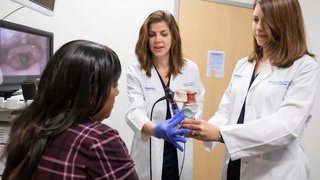
First, your disorder must be properly diagnosed through an exam, conversation with your doctor, and possibly a specialized procedure, which could mean:
- Videostroboscopy: A procedure where a doctor uses a strobe light and an endoscope to assess the vibration patterns and motion of the vocal cords.
- Laryngoscopy: A similar procedure where a doctor uses a camera to visualize the structure of your vocal cords and examine any abnormalities.
Patients at UT Southwestern also have access to mental health support to help restore their confidence. Your vocal care team can refer you to a psychologist or mental health counselor to navigate the emotional challenges associated with phonotraumatic voice disorders.
By synthesizing key information you provide about your lifestyle and your symptoms with diagnostic data taken from an exam, your doctor will be able to identify the correct treatment for your specific issue.
Some patients may need a microflap excision surgery to remove polyps. During this procedure, the surgeon makes a small incision on the side of the vocal cords, pulls up a small flap of tissue, removes the polyps, and lays the flap back down. This preserves the outer layer of the vocal cord and increases the chances that normal vocal function will return.
We also use various methods to treat phonotrauma without surgery. Our tools include laser treatments, intra-lesional steroid injections, and specialized singing-voice therapy.
And we are improving our ability to monitor and personalize vocal therapies. Our research team is currently working with people recovering from phonotraumatic voice disorders to help solidify new ways to measure the progress of their rehab through sensors that measure their voice use throughout the day.

UTSW Voice Care Center
The Voice Center at UT Southwestern provides state-of-the-art care for patients with voice disorders and other conditions affecting the larynx (voice box), airways, and swallowing function. Patients include professionals who rely on their voices – singers, actors, public speakers, broadcasters, lawyers, clergy, and teachers – as well as seniors or anyone experiencing vocal problems.
Tips to prevent phonotraumatic voice disorders
Anyone who speaks, sings, or yells for their career can benefit from these tips to prevent phonotraumatic voice disorders.
- Rest: Build in vocal rest breaks throughout the day to reduce inflammation and allow the tissue in your vocal cords to recover.
- Reduce vocal demand: In some cases, people with jobs or lifestyles that require heavy vocal loads can also take practical steps to reduce demands on their voices. Consistently moving closer to a person instead of yelling, rearranging the space where teaching, coaching, or performing takes place, or using a personal amplification system when teaching or speaking to groups of people can have a meaningful impact over time.

- Practice efficiency: Beyond these more basic measures, people can also learn to produce their voice more efficiently. With some expert training from a voice-specialized speech-language pathologist, you can learn to balance your respiratory system, your phonatory system, and your resonance system. This is an important concept because if your breathing and your vocal projection are imbalanced, it produces a hyper functional response, which essentially means that your vocal cords overcompensate and vibrate against each other with greater force. That in turn can cause injury to your vocal cords over time.
- Practice vocal exercises: Vocal exercises, including some already commonly used by professional singers, can help balance your breath and vocal projection. One is to use a straw to blow bubbles into a cup of water, then to gradually start using your speaking or singing voice through the straw. The bubbles provide a clear visual measure of the steadiness of your air flow so you can practice singing or speaking without overusing either your respiratory system or your resonance system.
You can also do pitch glides or lip bubbles, better known as "blowing raspberries." This is an especially fun exercise that parents can do with their kids. Humming and focusing sound toward the front of your mouth while maintaining steady breathing can also be helpful.
Protect your vocal health
Your voice is a precious thing. It is key to how you express your deepest feelings. It might also be how you make your living. If your voice is central to your life, you can benefit from information that will help you take care of your vocal cords and prevent voice disorders caused by phonotrauma.
If you are concerned that you may have vocal cord damage or if you have a phonotraumatic voice disorder, recovery is possible. Work with a voice care specialist who understands the challenges of vocal disorders to get the best outcomes.
To talk with an expert about care for phonotraumatic voice disorders, make an appointment by calling 214-645-8898 or request an appointment online.