When Karina Rodriguez felt a bump on Bailey May’s right leg last summer, she feared the worst. Tests confirmed that her constant companion for the past nine years – a shih tzu-poodle mix (shih-poo) – had a mast cell tumor, one of the most common skin cancers in dogs.
Surgery to remove the lump revealed the cancer had spread to a lymph node. Overwhelmed with questions and uncertainty, Karina wondered what more she could do.
“I was terrified of losing her,” Karina said.
She was referred to UT Southwestern Medical Center’s Veterinary Research and Oncology Clinic (VROC), believed to be the only clinic of its kind started by an academic medical center without an affiliated veterinary school. VROC offers some of the most innovative cancer therapies available to dogs and cats and connects every case directly to UTSW scientists’ pursuit of discoveries that could transform cancer treatments for humans.
“My heart felt a huge sense of relief. Bailey means the world to me. ... It gives me so much joy to know my sweet girl can one day help human patients, too.”
Karina Rodriguez
After eight weeks of therapy through one of VROC’s clinical trials, Bailey showed no evidence of cancer. She became VROC’s first graduate.
“My heart felt a huge sense of relief,” Karina said. “Bailey means the world to me, and I am extremely grateful to the entire VROC team for saving her life and giving us more time.”
The possibility that her treatment could one day open doors to help others is an added gift.
“She could be a little pioneer,” Karina said. “It gives me so much joy to know my sweet girl can one day help human patients, too.”
The vision behind VROC
A cancer diagnosis can be devastating for any family member – even the four-legged kind. Estimates show one in four dogs and one in five cats will develop cancer in their lifetime. Just like with people, the odds of pets getting cancer increase with age.
On a recent day at VROC’s Dallas clinic, not far from UT Southwestern’s nationally ranked Harold C. Simmons Comprehensive Cancer Center and its state-of-the-art Radiation Oncology buildings, staff members were busy caring for patients.
Bubba was being treated with doxorubicin, a drug that blocks a key enzyme that cancer cells need to grow. Mia was finishing a course of radiation for a mass on her lung. And there was Roman, a 5-year-old black Lab undergoing personalized ultra-fractionated stereotactic adaptive radiotherapy (PULSAR) for a cancerous mass near his tail.

Vespa, a feisty 15-year-old domestic shorthair cat and one of VROC’s few feline patients, was getting radiation therapy for advanced head and neck cancer.
Most vet clinics and hospitals that treat cancer offer surgery to remove tumors. But when surgery is not an option, or the cancer is diagnosed at an advanced stage, there’s little that can be done with traditional therapies. Cancer treatments for pets can also be cost prohibitive for many owners.
After several years of careful planning, UT Southwestern opened VROC in May 2025 as a not-for-profit clinic of care. The team recently celebrated the clinic’s first anniversary.
“It’s a very elegant research platform that is aiming to innovate clinical therapies for cancer,” said Ashish Ranjan, Ph.D., B.V.Sc., Director of VROC, Professor of Radiation Oncology, and Vice Chair for Comparative Oncology and Research Innovation at UT Southwestern.

Dogs and cats share the same living environments as people, and their cancers often develop in similar ways and respond to similar treatments.
Pets also have a compressed life span. Dogs live an average of 13 years while cats live for 15 years or so, which means that results from cancer treatments can be realized much sooner.
VROC collects data at every visit to better understand dosages, timing, and intensity of certain therapies and can quickly pivot if a particular treatment is not working.
“We do not cure enough people with cancer – we’ve got to do better,” said Robert Timmerman, M.D., Chair and Professor of Radiation Oncology at UT Southwestern who spearheaded efforts to launch VROC. “In terms of a translational model for people, there couldn’t be a better one than household pets. It’s the classic definition of a win-win.”
Clinical trials, no placebos
A research-driven philosophy shapes every aspect of care at VROC. The clinic is part of UT Southwestern, but it is set up to be self-supporting with grants that subsidize treatment costs through clinical trials. Any expenses not covered by grants must be paid by the pet owners. And while treatments are not free, the costs may be less, sometimes dramatically so, compared with what a private veterinary clinic might charge. VROC does not accept pet insurance.

“We’re not looking to make a profit,” said LaChandra Wilcox, the Clinical and Technical Manager at VROC. “We’re looking to make a change.”
Some patients, like Bailey, are referred to VROC from area vets. But in recent months, word of mouth about the clinic’s capabilities has attracted pet owners who contact it directly. Visits are by appointment only. Pets get an initial evaluation to identify and stage their cancer and determine whether they qualify for a clinical trial.
All pets treated at VROC must enroll in an approved clinical trial so that progress and outcomes can be measured. Operational guidelines ensure that pets get the best available treatments. And unlike some clinical trials in humans, there are no placebos.
“We will never give a treatment to an animal that we don’t think will have a good chance of helping them with their cancer,” Dr. Timmerman said.
One clinical trial, for example, is investigating the use of an iron replacement product called ferumoxytol with radiation therapy on pets with gliomas, which are tumors in the brain or the spinal cord.
Another trial is treating solid tumors with radiation therapy and high-intensity focused ultrasound (HIFU), a noninvasive procedure that uses sound waves to target and destroy diseased tissue.
Bailey’s clinical trial involved the use of a plant-based nanoparticle injected directly into the tumor that triggers the body’s immune system to recognize and destroy cancer cells.
“We have access to more cutting-edge clinical trial drugs and treatments that other places don’t,” Dr. Ranjan said. “So, there could be an option to have the pet treated if they qualify and hopefully be cured of their disease.”
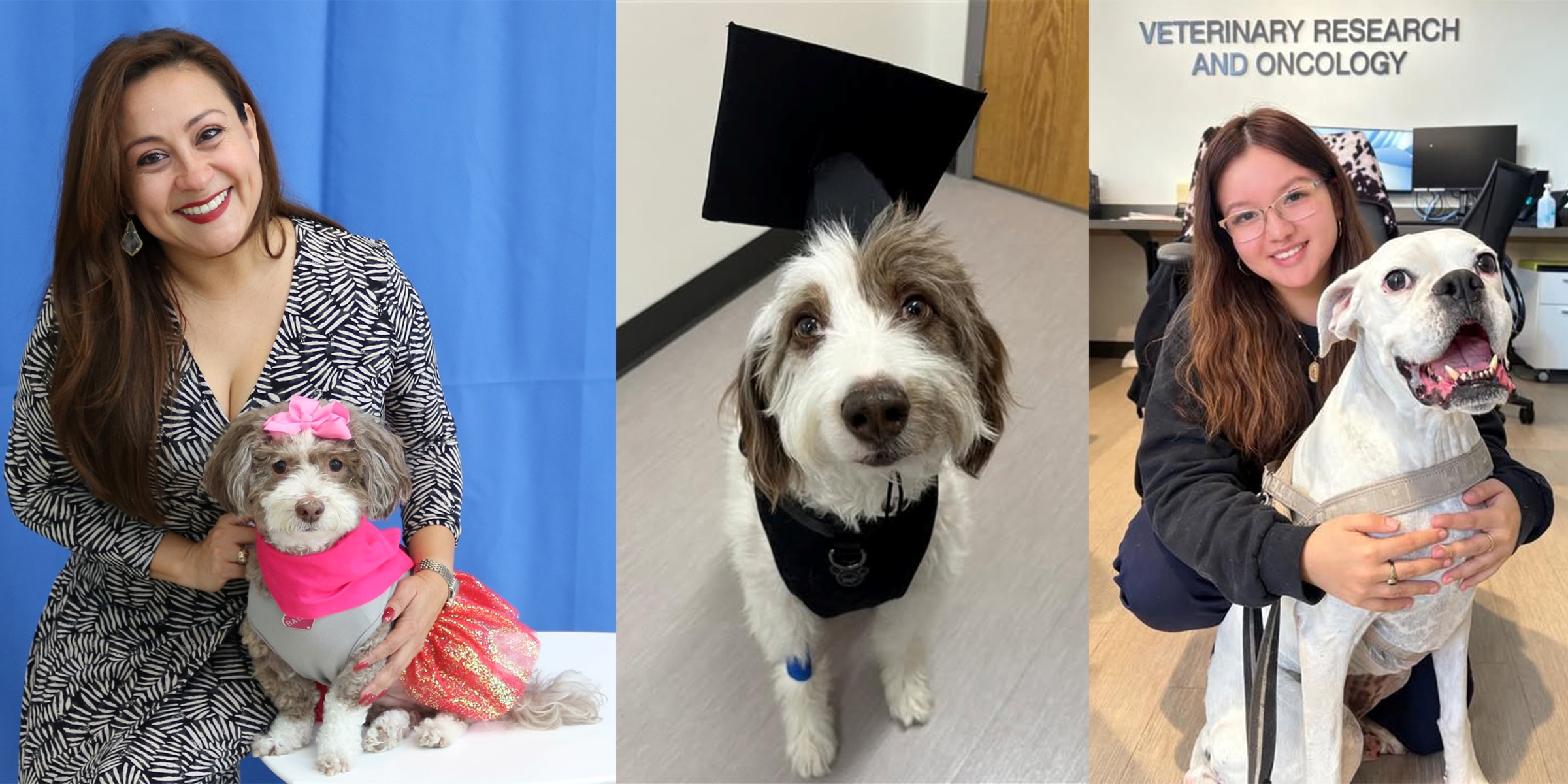
Since opening in May 2025, UTSW's Veterinary Research and Oncology Clinic has successfully treated 12 dogs and three cats. Among those graduates are, from left, Bailey May with her owner, Karina Rodriguez, Charlie, and Moonshine with VROC veterinary assistant Giavanna Macias.
What is a VROC visit like?
VROC operates on an outpatient basis, so owners drop off their pets in the morning for treatment and pick them up before the end of the day.
While UTSW’s Radiation Oncology Department sees hundreds of human patients each day, a busy day at VROC might involve only 10 pets. After-hours veterinary practices have partnered with VROC to handle any medical emergencies that might occur at night or on weekends.
For the safety of the pets and staff, all animals are given anesthesia before treatment. There’s a recovery room where dogs and cats can get warm blankets for comfort while staff members monitor their vitals and keep them company.
Mrs. Wilcox worked for nearly two decades as a radiation therapist for people before joining VROC. While she needed to brush up on the unique needs of veterinary care for her new job, which includes collaborating with vets and vet technicians, radiation therapists, and other specialists, she found that pet owners have many of the same concerns humans do when it comes to cancer care.
“The only thing on their minds is the c-word, and that can be a hard pill to swallow,” she said. “We want to make sure they have the information they need to make the best choice they can.”
She and her team also shower patients with hugs and belly rubs and offer emotional support throughout the cancer journey.
“They become part of the family,” Mrs. Wilcox said. “Our job is to guide them through from start to finish.”
A loyal companion’s legacy

Shambrekia Wise found VROC while searching online for canine clinical trials to help Chai, her 13-year-old husky pitbull mix who had been diagnosed with advanced oral melanoma. She reached out by email.
“I didn’t write them as a dog owner. I wrote them as a little girl who was losing her best friend,” said Shambrekia, who had shared adventures with Chai since he was 6 weeks old. When her daughter was born, he became the baby’s protector. And when Shambrekia was diagnosed with multiple sclerosis, he watched over her, too.
Chai qualified for a clinical trial at VROC that involved a nanoparticle-based immunotherapy enhanced with a checkpoint inhibitor and HIFU. Treatments initially helped, but they weren’t enough to beat back the cancer.
Still, Shambrekia called the team at VROC “angels” and said she’s beyond grateful to them for providing light during a dark time.
“I hope that Chai is able to give hope to other puppies too, even with just the short time that he participated,” she said. “I hope that he kind of gets to live forever in that way.”
Building knowledge, one patient at a time
Since opening last year, VROC has evaluated 178 companion animals and provided 285 treatments among 49 pets whose owners opted to enroll them in a clinical trial. So far, 12 dogs and three cats have graduated after successfully completing treatment. Each case adds to a growing body of data.
“We still have a lot to learn,” Dr. Ranjan said. “If some of these approaches demonstrate significant clinical benefit, they could have a long-lasting impact on the way we practice medicine.”
As part of her clinical trial, Bailey May will continue to receive regular checkups. At a recent visit to VROC, the shih-poo’s sassy personality was on full display while wearing red and white bows and a red skirt to match.
“The love they have for Bailey – I can feel that,” Karina says. “I know she’s in good hands.”
Karina says she hopes their experience will raise awareness and encourage others. VROC gave Bailey a second chance. And if the knowledge from her care eventually leads to more happy endings for other pet owners – and possibly people too – Karina said: “That’s just incredible.”
Drs. Ranjan and Timmerman are both members of the Harold C. Simmons Comprehensive Cancer Center at UT Southwestern. Dr. Ranjan holds the Robert B. and Virginia Payne Professorship in Oncology. Dr. Timmerman holds the Effie Marie Cain Distinguished Chair in Cancer Therapy Research.

Make an appointment
The Veterinary Research and Oncology Clinic (VROC) is located on the UT Southwestern campus in Dallas. Clients may receive a referral from their veterinarian or contact the clinic directly. Visits are by appointment only. To determine whether your dog or cat might be eligible for cancer treatment, call 214-645-6221 or email VROC@UTSouthwestern.edu.