Dallas man is Texas’ first recipient of novel therapy for eye cancer that spreads to liver
July 23, 2026


By Renee Yan

Tom Hartley is an explorer at heart. In his 72 years, he has traveled to some of the most astonishing corners of the world and seen some wondrous sites: the 144-year-old Sagrada Família church in Barcelona; a massive 82-meter waterfall on the Iguazu River in South America; and the acqua alta (“high water”) tide in Venice, Italy, just to name a few of his favorites.
So, when UT Southwestern doctors asked him if he would be the first patient in Texas to receive an innovative therapy to treat his metastatic uveal melanoma, a rare and aggressive form of eye cancer that had spread to his liver, Tom never hesitated.
His intrepid spirit kicked in.
“I wasn’t the least bit frightened about being the first,” he said. “In fact, I thought it was kismet that I’d come to UT Southwestern. I just happened to be at the right place at the right time to have the right outcome.”
The Hepzato Kit, a proprietary drug/device from Delcath Systems Inc., is the only whole-liver therapy of its kind that has been approved by the U.S. Food and Drug Administration (FDA) to treat metastatic uveal melanoma, which spreads to the liver in up to 90% of cases. It works by utilizing a series of balloon catheters to isolate blood flow to and from the liver. The kit then delivers high doses of the chemotherapy drug melphalan via the hepatic artery to the entire liver before it is pumped through a specialized extracorporeal filtration unit that eliminates the drug from the blood. Currently, Hepzato is only available at fewer than three dozen medical centers across the country.

On Jan. 15, 2026, Tom, a retired paralegal who lives in Dallas, became the first patient in Texas and the surrounding region to receive this new treatment. Adrienne Shannon, M.D., Assistant Professor of Surgery and a surgical oncologist at UT Southwestern, led the team performing Tom’s procedure. She had previously treated patients using the Hepzato Kit at Moffitt Cancer Center in Tampa, Florida, before joining UT Southwestern in 2025.
“Hepzato is the only FDA-approved treatment that treats the whole organ and has proven to shrink tumors, translating into more effective disease control and potential survival benefits. It is not a cure, but it can control the disease and afford patients the opportunity to receive follow-up therapy in the future,” said Sanjay Chandrasekaran, M.D., Assistant Professor of Internal Medicine in the Division of Hematology and Oncology and member of the Harold C. Simmons Comprehensive Cancer Center. A clinical expert of uveal melanoma and other skin cancers, Dr. Chandrasekaran also helped lead the multidisciplinary team caring for Tom, who said he had no reservations about being a Texas trailblazer.
“I had the best doctors, and I had the best nurses,” he said. “I've been in the hospital a bunch during my lifetime, and I know good doctors and nurses when I see them.”
Cancer, in the blink of an eye
In 2019, Tom visited his optometrist for a general eye exam, and a spot of hyperpigmentation called a nevus was detected in the retina of his right eye. A few months later, Tom began seeing floaters in his field of vision. They looked like air bubbles drifting to the surface in an aquarium, Tom said, and they were progressively getting bigger and more frequent. An appointment with a local ocular oncologist confirmed Tom’s worst fear: He had cancer in his eye.
In June 2020, Tom received plaque radiotherapy, which involves surgically attaching a small device to the outside surface of the eye to deliver radiation directly to cancer cells.
The treatment was successful, and Tom began receiving regular magnetic resonance imaging (MRI) scans every six months to monitor his health. In March 2023, one such scan revealed a nodule in Tom’s bladder. The diagnosis was unrelated to the uveal melanoma, but it ultimately led him to seek help from Vitaly Margulis, M.D., Professor of Urology at UT Southwestern and a member of Simmons Cancer Center, who used blue light cystoscopy and immunotherapy to remove the growths.
It was the first time Tom sought help from UT Southwestern, but it wouldn’t be the last.

What to know about uveal melanoma
Uveal melanoma is a cancer that springs from the cells that create melanin within the eye and accounts for about 5% of all melanoma cases in the U.S. Its cause is not clearly known, and unlike some other types of melanomas, there is no direct correlation between risk and UV light exposure. However, men, older patients, and people of Caucasian descent generally see a greater risk.
Some patients might experience symptoms such as floaters, blurred or distorted vision, or some amount of vision loss, but there are also those who are asymptomatic. There is no standard guidance on disease prevention, but doctors recommend an annual comprehensive dilated eye exam for screening.
Trapped in the liver
In March 2025, nearly five years after he was treated for a uveal melanoma primary tumor, an MRI scan and follow-up diagnostic laparoscopy revealed several spots on his liver, ranging from 1.5 centimeters to barely a couple of millimeters. The cancerous cells had spread from his eye.
Primary treatment of uveal melanoma is more than 90% effective at controlling local disease, said Dr. Chandrasekaran, who began seeing Tom after this latest development. But about 50% of patients with uveal melanoma will experience cancer metastases, and because the eye lacks a lymphatic system, cancer cells spread via the bloodstream about 90% of the time to the liver, where they get trapped. Some patients discover this years later during a subsequent doctor’s visit – as Tom had – but medical advancements have made it possible to detect a patient’s risk of metastasis early.

J. William Harbour, M.D., Chair and Professor of Ophthalmology at UT Southwestern and member of the Cellular Networks in Cancer Research Program of Simmons Cancer Center, is a pioneer in the treatment of ocular melanoma and developed two prognostic tests that are now considered the standard of care for risk stratification for uveal melanoma: the 15-gene expression profile (15-GEP) test and the PRAME test.
“These tests are important in informing our surveillance plans for patients and how we approach treatment,” Dr. Chandrasekaran explained.
And for years, treatment for this type of cancer was limited. Chemotherapy is not commonly used, and other systemic therapies generally used for melanomas – such as immunotherapy drugs – were less effective and only available for certain patients. What’s more, they can lead to more adverse effects throughout the body. On the other hand, treatment strategies targeting specific segments of the liver do not treat the whole organ, which means they are less effective against multifocal disease as seen in Tom’s case.
The introduction of Hepzato changed this paradigm. It allowed patients like Tom to have the best of both options: High doses of chemo circulated throughout the liver with minimized effects on the rest of the body. And the results were undeniable.
A multicenter phase three study found that among 91 individuals who received Hepzato, 36.3% of patients experienced shrinkage of their tumors, including 7.7% of whom experienced a complete disappearance of liver lesions. The majority of tumor responses were seen after the first two cycles of therapy. The study also found an overall survival rate of 80% after one year, and 65% of patients were progression-free at six months.
“This approach was a far more effective option for Tom than other liver-directed methods that only treat one segment of the liver at a time,” Dr. Shannon said. “It can improve our patient’s progression-free survival.”
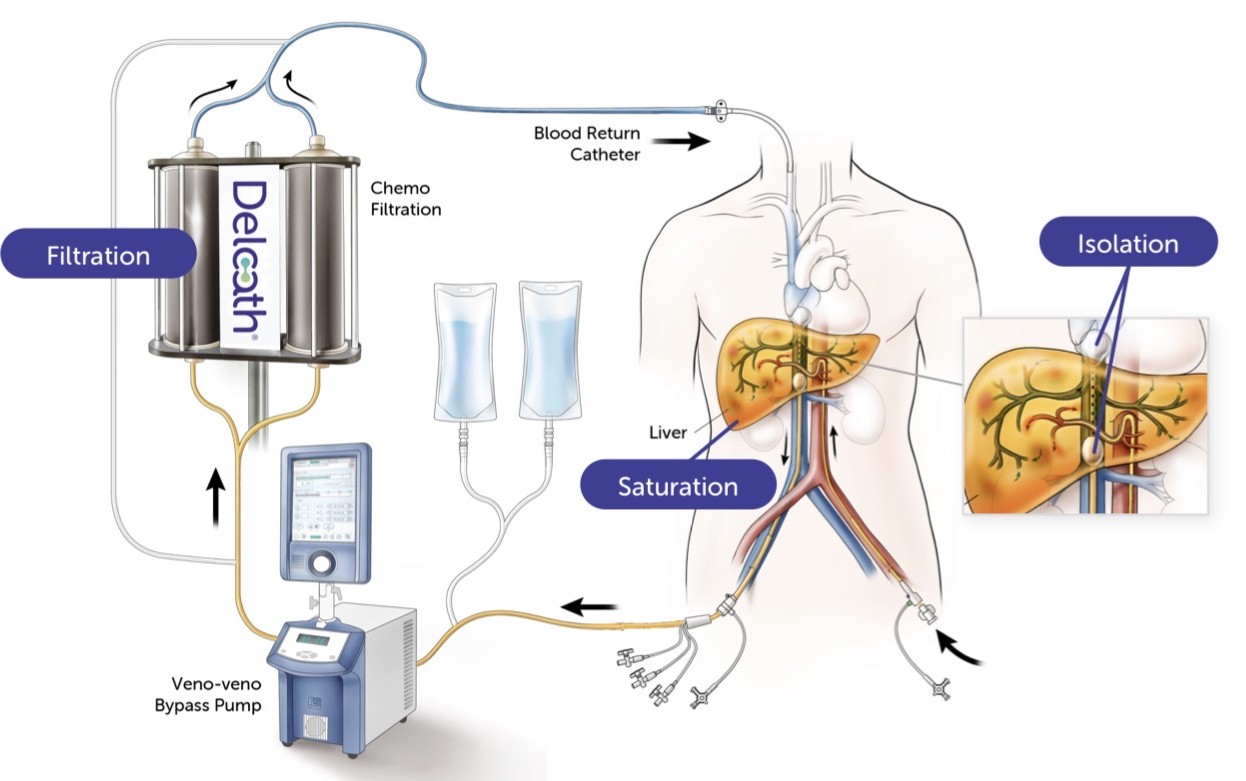
Hepzato Kit treats cancer with veno-venous bypass and infusions of high doses of the drug melphalan to the whole liver. Specialized balloon catheters and an extracorporeal filter system are used to contain the drug within the liver and its blood vessels so that systemic side effects are minimized. (Credit: Delcath Systems)
What should patients expect?
When Tom and his doctors first discussed treatment options, he made it clear he wanted to stay close to his home in Dallas rather than seeking care elsewhere – even if it meant Hepzato would not be available to him.
“Dr. Chandrasekaran talked about it, and I even dreamed I got the procedure once,” Tom recalled. “Months later, Dr. Shannon arrived from Moffitt, and it all just fell into place.”
Tom met the basic criteria for Hepzato: His liver was still functioning sufficiently, the tumors comprised less than 50% of the organ, and his blood cell counts were high enough to withstand the effects of chemotherapy.

The day of the procedure, Dr. Shannon was joined in the OR by a team of interventional radiologists led by Sanjeeva Kalva, M.D., Patrick Sutphin, M.D., Ph.D., and Seung Kim, M.D., M.B.A.; anesthesiologists led by Steven Zheng, M.D.; and perfusionists, who play vital roles in isolating the liver and safely delivering the high-dose chemo directly to the organ.
First, the interventional radiologists used an angiogram to confirm Tom’s blood vessels were clear. Then, they carefully placed the specialized balloon catheters along the blood vessels supporting the liver, isolating its blood flow and allowing Dr. Shannon and the perfusionists to begin infusing melphalan to the liver – a process that takes about 30 minutes – before the filtration unit begins cycling the drug from Tom’s system.
“One minute the anesthesiologist was telling me to take a deep breath, and the next, I was waking up in the ICU four and a half hours later,” Tom said.
Post-procedure, most patients are kept under observation for about 24 hours, but Tom stayed at the hospital an extra day as a precaution. He had an elevated level of troponin proteins in his blood – a typical side effect of Hepzato – and his red blood cell count was down.
“Dr. Shannon was with me three times a day during my time at the hospital, and Dr. Chandrasekaran saw me five times the first two days,” Tom said.
The biggest challenge was his lack of energy and stamina in recovery, he said. He needed a blood transfusion in February to help him recuperate. Patients typically feel back to normal after 48 hours, but, according to Tom and his medical team, it’s possible his age, weight, and sedentary lifestyle may have prolonged his recovery period.
“It’s no fault of the procedure. It’s just the way my body responded to treatment,” Tom said. “By the second week of April, I was planting flowers and doing yard work like normal again.”
Ready for the next adventure
Today, Tom said he feels fully recovered, and his liver cancer has stopped progressing, with one tumor actually shrinking half a centimeter. Although this treatment can be repeated up to six times every 6-8 weeks, he and his medical team have agreed to wait to see if another round of chemotherapy is needed.

“If I didn’t know better, I wouldn’t think anything was wrong. I have no pain, and I feel great,” said Tom, who is hopeful he and his partner will be off on their next adventure later this year.
The UTSW team has since performed 10 procedures using Hepzato, an important advance in treatment for a rare and complex cancer.
“Having the ability to offer Hepzato to our patients is so important,” said Dr. Chandrasekaran, who has received institutional funding to grow the uveal melanoma program at UT Southwestern. “Treating this deadly disease is about creating opportunity – the opportunity for patients to have access to a wide scope of options, including systemic therapies, clinical trials, and liver-directed treatments.”
What’s more, the treatment may also help patients with other types of cancers in the future. A team with UT Southwestern’s Multi-Histology and Precision Oncology Program (MPOP) in the Simmons Cancer Center is planning to offer Hepzato to select patients with metastatic breast and colorectal cancers.
“This achievement exemplifies the strength of UT Southwestern as a premier institution for interdisciplinary patient care, discovery-driven research, and the development of breakthrough therapies,” Dr. Harbour said. “It’s an exciting moment for our expanding ocular oncology program as we rapidly establish UT Southwestern as a national destination for patients with eye cancers.”
Dr. Harbour has served as a consultant for Castle Biosciences and Ideaya Biosciences. Darovasertib is under clinical development by Ideaya Biosciences. Dr. Harbour holds The David Bruton, Jr. Chair in Ophthalmology.
Dr. Chandrasekaran has served as a consultant for Delcath Systems Inc. He is a Eugene P. Frenkel, M.D. Scholar in Clinical Medicine.
To discuss treatment options for uveal melanoma, call 214-645-4673 or request an appointment online. For nonurgent inquiries about the uveal melanoma program, email us at uvealmelanoma@utsouthwestern.edu.