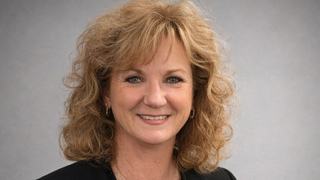
In November 2013, 42-year-old Paige Montgomery developed the most ferocious headache she’d had in over 25 years of living with severe migraines. It was the holidays, and as the manager of a busy retail department, trying to work through waves of nausea and dizziness wasn’t ideal.
When Paige began vomiting, a coworker offered to drive her home. That car ride should have taken 15 minutes. Instead, it took nearly three hours. Paige couldn’t remember how to get home.
Once she finally found her neighborhood and the unit she shared with her mother, Paige wanted just to take her migraine medication and sleep. Her mother urged her to go to the emergency department, and at 1 a.m., Paige let her nephew drive her to a local hospital.
Waiting much longer could have been fatal. This was no migraine – it was a ruptured aneurysm that had caused a hemorrhagic stroke. The right side of her brain was bleeding from three of its four ventricles.
Paige was swiftly transferred to Zale Lipshy University Hospital at UT Southwestern, now the Zale Lipshy Pavilion – William P. Clements Jr. University Hospital at UT Southwestern, which is an Advanced Comprehensive Stroke Center.
Babu G. Welch, M.D., was the neurosurgeon on call. After performing emergency brain surgery and doing rounds of advanced imaging, Dr. Welch and his colleagues would diagnose Paige with moyamoya disease, a rare cerebral vascular disorder that almost never occurs in people who look like her.
What is moyamoya disease?
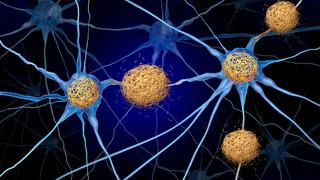
Moyamoya disease is a progressive brain disease characterized by the narrowing of the carotid arteries at the base of the brain. This reduces blood flow, causing bleeding (hemorrhagic) or nonbleeding (ischemic) strokes.
The body tries to respond by creating new tiny blood vessels to restore blood flow to the brain, but the new ones are too often fragile and may break or become blocked. The result is bleeding, recurrent small strokes, and seizures.
Moyamoya disease is a primary condition; it is different from moyamoya syndrome, which is caused by another health condition such as sickle cell disease or uncontrolled diabetes. The disease affects less than one out of 100,000 people each year in the U.S. Most people with moyamoya disease are of Asian ancestry and are diagnosed as children or young adults.
Moyamoya diagnosis and treatment require a culture of collaboration. UT Southwestern’s team of neurosurgeons, neurologists, and neuroradiologists have decades of experience evaluating and treating patients with the disease and syndrome.
Related: Read: "Moyamoya disease and syndrome: Knowing the difference can prevent a stroke"
At least 25 strokes
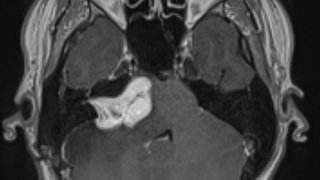
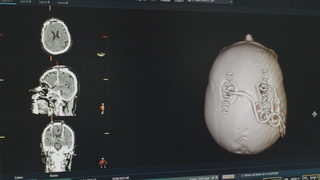
Paige’s hemorrhagic stroke had left her partially paralyzed on her left side, and she had lost partial ability to understand and produce speech (aphasia). Over the next three weeks, MRIs and CT scans showed she’d had at least 25 ischemic strokes over the years.

Many of the migraines Paige had dealt with since her teens were likely misdiagnosed transient ischemic attacks (TIAs), which are sometimes called ministrokes – a misnomer, since any size of stroke can damage the brain.
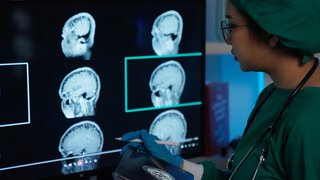
Based on the imaging and Paige’s health history, the cerebral vascular team suspected moyamoya disease. So, they conducted a brain angiogram – advanced imaging that uses X-rays and contrast dyes to show blood flow through the vessels of the neck and brain as well as potential blockages, aneurysms, and unusual formations.
Despite not fitting the typical patient profile, Paige had full-blown moyamoya disease. Her angiogram revealed an overgrowth of extra blood vessels that had “crept up” on Paige’s brain – these telltale “puff of smoke” vascular formations looked like wispy billows floating in the air.
“She's one of maybe two patients with moyamoya disease we’ve seen in the last 20 years who wasn't of Asian descent and who had a bleeding stroke,” Dr. Welch said.
A second brain surgery
After a stroke, undamaged parts of the brain can sometimes take over and restore blood flow to the injured side. But Paige’s stroke had been so severe that her brain was struggling to heal.
“Blood flow between the halves of the brain is like two irrigating fields,” Dr. Welch said. “If one field goes down, water can come over from the other field to help keep the grass green. But Paige’s stroke ripped through her whole brain, and that shared irrigation – that blood flow – couldn’t occur.”
Paige needed another surgery to restore blood flow and preserve her brain. In February 2014, Dr. Welch performed a direct bypass surgery, connecting her superficial temporal artery (STA), which pulses in front of the ear, to her middle cerebral artery (MCA) in the front and center areas of the brain. Like a heart bypass, the STA-MCA surgery rerouted blood flow to replenish the tissue and potentially prevent new strokes.
The surgery requires several weeks of recovery, including multiple days in the hospital. During that time, Paige’s bubbly personality shined through despite her communication challenges.
“The biggest thing about Paige was her attitude,” Dr. Welch said. “You don’t expect to have cognitive issues in your mid-40s. Once in a while, she didn't want to smile. But she found a way every time.”
Paige’s positivity would carry her through a challenging year of inpatient stroke rehabilitation.
Road to stroke rehab

Hemorrhagic strokes typically take longer to rehab than ischemic strokes do for many reasons:
- Blood is an irritant to the delicate tissues of the brain.
- Patients often have more significant physical weaknesses and aphasia.
- There is often deconditioning involved due to lengthier bed rest that is part of recovery.
Moyamoya disease-related strokes are even more complex. Patients are often younger, and their deficits are more disruptive. Cognitive changes are a little more prominent, and the ability to come up with new thoughts and actions can degrade over time. Paige would have to learn to speak, walk, and even think clearly again as well as navigate lifestyle changes with her new moyamoya disease diagnosis.
But giving up has never been in Paige’s vocabulary. Despite the damage to her brain, her body was healthy. And she was motivated – she was not going to fail.
Preparing for the journey
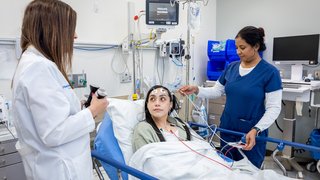
Before a patient begins stroke rehab, the UTSW Physical Medicine and Rehabilitation team led by neurological rehabilitation specialist Benjamin Nguyen, M.D., assesses the baseline – how much of the patient’s physical and cognitive functions have changed. Patient and family input is key; the goal is to set everyone up for a successful transition out of the hospital.
From there, the team creates a customized plan for physical, occupational, and speech therapy to achieve what matters most to the patient, such as improvements in vision, speech, sensation, energy, and ability to follow directions. In some cases, patients can rebuild their strength and dexterity at home through an outpatient rehabilitation program. But for Paige, who was starting nearly from square one, inpatient rehab made the most sense.

Care at UT Southwestern
UT Southwestern is ranked by U.S. News & World Report as one of the nation’s top 10 hospitals for Neurosurgery and Neurology and one of the top 15 hospitals for rehabilitative care. The Department of Physical Medicine and Rehabilitation offers a wide range of services, personalized for each patient.
It is one of the premier physician and therapist training centers in the country and the only program in North Texas conducting both translational and clinical research in the areas of brain injury/concussion, burn rehabilitation, stroke, ambulation and falls, epilepsy, and spinal cord injury.
For stroke patients, rehabilitation specialists assist with mobility, help build strength, develop cognitive and behavioral strategies to help compensate for deficits, enhance skills needed for daily activities, improve balance, and restore physical function.
Year of rebuilding that starts from scratch
After the bypass surgery, Paige spent a few weeks in the inpatient rehabilitation program at UT Southwestern. From there, she was referred to Pate Rehab, a private facility in Anna, Texas, that specializes in helping people after traumatic brain injury.
“I lived there just over a year to become functional again, physically, mentally, and cognitively,” Paige said.
"Feeling some negativity in a situation like that is normal, but I learned it doesn’t help you. If I wanted to get better, I had to stay positive, learn coping skills, and trust the process."
Paige Montgomery
All the areas of Paige’s brain that had been damaged by the stroke had to be restored, and that takes time. Her rehab was divided between cognitive and physical activities, such as:
- Using flashcards to remember words
- Doing paint-by-number projects to recall colors and numerals
- Repeating words with therapists
- Practicing getting dressed, getting in and out of a wheelchair, and using the bathroom independently
There were depths of depression – days when she didn’t want to try.
“I would get frustrated by not being able to remember words and details when I wrote to my mother,” Paige said. “It was difficult having to rely so much on others for everything. Feeling some negativity in a situation like that is normal, but I learned it doesn’t help you. If I wanted to get better, I had to stay positive, learn coping skills, and trust the process.”
Through all the challenges, the teams at Pate and UT Southwestern were there for her 200%, Paige said. They, along with her mother, encouraged her to push forward.
A year after she arrived at Pate in her pink and black zebra-striped wheelchair, she was able to leave on her own two feet with her walker. And she hasn’t stopped moving in the decade since.
Maintaining health
Paige is now 55, and she’s back at work part-time doing what she loves – working in customer retail sales. Today, her health routine is a lot different than before her diagnosis. She takes a combination of finely tuned medications that are tweaked constantly, including:

- Botox, which helps control her migraine headaches
- Zonisamide, an anti-seizure medication
- Carbidopa, a Parkinson’s disease drug that stabilizes her orthostatic hypertension (blood pressure that increases upon standing)
She sees Steven Vernino, M.D., Ph.D., and her other UT Southwestern neurologists a few times a month. A couple times a year, she visits Dr. Welch for an angiogram and an MRA NOVA study– a new imaging exam that tracks the moyamoya disease progress and her brain health over time.
“My care team is amazing,” Paige said.
The doctors, therapists, and nurses help her stay ahead of regular, age-related health issues that could make her moyamoya symptoms worse, such as high blood sugar or blood pressure, and monitor her nutrition and hydration.
Her mother, who took care of her and was her biggest cheerleader, died in August 2025. Her UTSW doctors each called Paige personally to make sure she was OK.
“I had the privilege of taking care of my mother for the last two years of her life,” Paige said. “While it’s been difficult not having her with me, I have my UT Southwestern team to thank for getting me well enough to care for her.”
Paige not only survived but she also found her true calling as an advocate for people with moyamoya disease. She regularly hosts speaking engagements to raise awareness, and she’s mentored more than 60 fellow patients from all over the world through their own rehab experiences.
“When people see me now, they do a double take; they say I’m like a whole different person,” Paige said. “That’s why I say UTSW is my hospital. I'll never leave this team.”
To talk with an expert about moyamoya syndrome or disease, make an appointment by calling 214-645-2300 or request an appointment online.