


Our team of hundreds of leading cancer physicians and oncology-trained support staff is a trusted partner in returning patients with cancer to good health.
Uveal Melanoma
New Patient Appointment or 214-645-4673
At UT Southwestern Medical Center, our specialists provide expert care for uveal melanoma, a rare type of melanoma that is also the most common ocular (eye) cancer in adults. We help treat the primary disease, protect vision, and manage the disease once it has spread.
As the only National Cancer Institute (NCI)-designated Comprehensive Cancer Center in North Texas, we provide access to the latest diagnostic tools and treatments available. NCI designation also means that we offer the broadest possible range of clinical trials, giving patients access to potential therapies not available at other facilities.

What Is Uveal Melanoma?
Uveal melanoma is a rare eye cancer that develops in the uvea, the middle layer of the eye. This layer includes the iris (the colored part of the eye), the ciliary body (a ring of tissue behind the iris), and the choroid (a layer of blood vessels behind the retina). Though uncommon overall, uveal melanoma is the most frequent eye cancer in adults.
This cancer begins when pigment-producing cells (melanocytes) in the uvea grow out of control and form a tumor. Unlike skin melanoma, there are no common risk factors for uveal melanoma, such as increased sun exposure. Its exact cause is unknown, but genetic changes in the tumor cells play a key role.
Because it grows inside the eye, uveal melanoma often causes no early symptoms. Doctors may find it during a routine eye exam, and prompt diagnosis and care are essential to treat the tumor, protect vision, and prevent the cancer from spreading.
Why Choose UT Southwestern for Uveal Melanoma Care?
At UT Southwestern, patients with uveal melanoma receive care from one of the nation’s most experienced teams in ocular oncology. We combine advanced technology, research expertise, and compassionate support to deliver the best possible outcomes for patients.
Our patients benefit from:
- Multidisciplinary expertise: Our team includes ophthalmologists (eye specialists), oncologists (cancer specialists), ocular oncologists (specialized eye surgeons who focus on eye cancers), surgical oncologists, and interventional radiologists.
- Advanced treatment options: We offer leading treatments, such as plaque brachytherapy for eye tumors and liver-directed therapies and other systemic therapies for cancer that has spread, along with access to promising clinical trials.
- Proven results: Our success rates with plaque brachytherapy are among the highest reported worldwide, reflecting decades of expertise in this specialized treatment.
- Personalized care: From active monitoring to advanced cancer therapies, we offer the full range of treatment approaches. Our experts work together and with patients to create personalized treatment plans.
- Coordinated support: We help patients navigate every step of care, from protecting vision to addressing emotional and practical needs.
- Research-driven innovation: As part of a top academic medical center, we are actively involved in research that is shaping the future of uveal melanoma care.
What Are the Symptoms of Uveal Melanoma?
Many people have no symptoms in the early stages of uveal melanoma. When symptoms occur, they may include:
- Blurred or decreased vision in one eye
- Flashes of light or floating spots (floaters)
- A dark spot on the iris
- A change in the shape of the pupil
- Loss of side (peripheral) vision
Because these symptoms can signal other eye conditions, it is important to see an ophthalmologist for evaluation.
What Are the Types of Uveal Melanoma?
Doctors classify uveal melanoma by the part of the eye where it develops:
- Iris melanoma: This type grows in the colored part of the eye. Iris melanoma tends to grow slowly and may be easier to detect.
- Ciliary body melanoma: These tumors grow in the ring of tissue behind the iris. Ciliary body melanoma is usually harder to detect until it grows larger.
- Choroidal melanoma: This type is the most common and forms in the vascular layer behind the retina.

How Is Uveal Melanoma Diagnosed?
Our ophthalmologists usually begin with a routine eye exam. During the exam, we dilate the pupils and use indirect ophthalmoscopy for a comprehensive evaluation.
If we suspect uveal melanoma, we may order other tests, including:
- Ultrasound of the eye: This imaging test uses high-frequency sound waves to measure the tumor’s size and location.
- Fundus photography: A special camera captures detailed pictures of the back of the eye, allowing doctors to document and monitor changes over time.
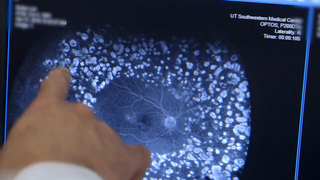
- Fluorescein angiography: We inject a fluorescent dye into a vein in the arm and take photos over several minutes as the dye travels through blood vessels in the eye. Fluorescein angiography helps identify problems with blood vessels that could indicate cancer.
- Optical coherence tomography (OCT): This noninvasive imaging test uses light waves to create cross-sectional images of the eye. OCT shows the various layers, including the uvea and the retina, and can reveal an eye melanoma.
- Biopsy: In rare cases, we may take a small sample of uveal melanoma cells to examine under a microscope. A biopsy can help us confirm a diagnosis and guide treatment.
- Tests for cancer spread: We may use computed tomography (CT), magnetic resonance imaging (MRI), or ultrasound to see whether the cancer has spread to other parts of the body.
How Is Uveal Melanoma Treated?
Treatment aims to destroy the tumor, preserve vision when possible, and prevent cancer from spreading. At UT Southwestern, our treatment options include:
- Active monitoring: A small uveal melanoma tumor can look like a benign growth called a nevus (mole). In these cases, we often monitor with regular ocular oncology exams. Tumors that grow are more likely to be cancerous and need further treatment.
- Photodynamic therapy (PDT): This treatment uses light energy to activate a medication called a photosensitizer to destroy cancerous and precancerous cells. We use PDT mainly for smaller uveal melanoma tumors.
- Thermotherapy: This treatment uses infrared light from a laser to slowly heat and destroy cancer cells. We often combine thermotherapy with radiation therapy, such as plaque brachytherapy, to treat uveal melanoma.
- Plaque brachytherapy: Brachytherapy is internal radiation therapy, which uses a radioactive material sealed inside seeds to aim radiation at a tumor. With plaque brachytherapy, we place a small piece of metal with attached radioactive seeds on the outside of the eye. The custom-designed plaque focuses radiation on the tumor while shielding nearby tissues, and we remove the plaque after several days. Since 2000, the UT Southwestern ocular oncology team’s success rate with plaque brachytherapy has been among the highest reported worldwide.
- Surgery: Procedures to treat uveal melanoma include removing the tumor or the entire eye. Resection removes the tumor and a small amount of surrounding tissue. We perform enucleation to remove the entire eyeball for very large tumors.
Treatments for cancer that has spread
Metastatic uveal melanoma is cancer that has spread to other areas, most often the liver. Treatment options for metastatic uveal melanoma include:
- Immunotherapy: These cancer medications help the body’s immune system recognize and attack cancer cells.
- Targeted therapy: These cancer medications target parts of melanoma cells that make them different from healthy cells.
- Liver-directed therapies: Our ocular oncology team includes liver experts from surgical oncology and interventional radiology to treat uveal melanoma that has spread to the liver. Treatment options include:
- Resection (surgery)
- Embolization (local treatment to cut off tumor blood supply) with immunotherapy, radiotherapy, or chemotherapy
- Ablation (direct probe insertion to destroy cancer tissue)
- Percutaneous hepatic perfusion/PHP (whole liver chemotherapy)
- Clinical trials: We offer clinical trials for patients whose tumors do not respond to standard-of-care options.

What Support Services for Uveal Melanoma Does UT Southwestern Offer?
Support services play an important role in cancer care. Our specially trained staff meets with patients and their loved ones during and after treatment. We provide support and information for patients at every stage of uveal melanoma.
Cancer supportive care at UT Southwestern includes:
- Cancer psychology: Meet with a licensed clinical psychologist who is specially trained to help cancer patients.
- EMBRACE Survivorship: EMBRACE is a half-day survivorship symposium designed to assist patients and their families with physical, emotional, and practical issues that can arise during the cancer journey.
- Integrative therapies: Activities such as guided imagery, meditation, and expressive writing aim to improve patients’ well-being and quality of life during and after cancer treatment.
- Oncology nutrition: Our dietitians help patients make informed food choices that are best for their health at various stages of cancer treatment and beyond.
- Oncology rehabilitation: Cancer rehabilitation specialists help patients and survivors maintain or return to their optimal function and quality of life.
- Oncology social work: Social workers trained to work with cancer patients are available to assist with any challenges faced during or after treatment.
- Spiritual support: Our chaplains offer interfaith support for patients and their families and caregivers.
- Support groups and classes: Meeting with others in similar situations can be helpful and cathartic.
What Clinical Trials Are Available for Uveal Melanoma?
Clinical studies are crucial in advancing uveal melanoma care. These trials offer patients access to promising new therapies before they are widely available, while improving our understanding of the disease.
The Harold C. Simmons Comprehensive Cancer Center at UT Southwestern offers several clinical trials for adult patients who have uveal melanoma. Current and upcoming clinical trials are studying targeted therapies, immunotherapy, and other treatments for patients at all stages of uveal melanoma, including metastatic disease.
In these studies, some patients receive treatment before the main treatment (neoadjuvant), during treatment (adjuvant), or or in the metastatic setting. One of these studies is a phase 2/3 study of RP2 (an intratumorally injected genetically modified herpes simplex type 1 virus) in combination with nivolumab (infusional immunotherapy) to treat metastatic uveal melanoma in patients who have not received prior treatment with immune checkpoint inhibitors.
Related Conditions and Treatments



MedBlog
Results: 3 Locations
Melanoma and Sarcoma Clinic
at Cancer Care Outpatient Building 6202 Harry Hines Blvd., 9th FloorDallas, Texas 75235 (214) 645-4673 Directions to Melanoma and Sarcoma Clinic at Cancer Care Outpatient Building, Dallas Parking Info for Melanoma and Sarcoma Clinic
Ophthalmology Clinic
at James W. Aston Ambulatory Care Center 5303 Harry Hines Blvd., 6th FloorDallas, Texas 75390 214-645-6913 Directions to Ophthalmology Clinic at James W. Aston Ambulatory Care Center, Dallas Parking Info for Ophthalmology Clinic
UT Southwestern Ophthalmology at North Dallas
1125 E. Campbell Road, Suite 125Richardson, Texas 75081 214-645-0950 Directions to UT Southwestern Ophthalmology at North Dallas at UT Southwestern Ophthalmology at North Dallas, Richardson