

Search for opportunities to participate in a muscle or bone research study.
Foot and Ankle Conditions
New Patient Appointment or 214-645-8300

Nationally Ranked in Orthopaedics
UT Southwestern Medical Center is ranked the No. 1 hospital for orthopaedic care in Dallas-Fort Worth and among the best nationally by U.S. News & World Report.

For patients who have foot and ankle injuries or conditions, every step can be painful, keeping them from activities they love and making everyday tasks a challenge.
UT Southwestern Medical Center’s orthopaedic surgery team is made up of specialists who focus on specific areas of the body, resulting in highly specialized care. Our orthopaedic and podiatric foot and ankle surgeons provide comprehensive diagnostic, treatment, and rehabilitation services to patients of all ages who have foot and ankle injuries and conditions. We use conservative treatments when possible and offer advanced surgical options when needed.

What Are Foot and Ankle Conditions?
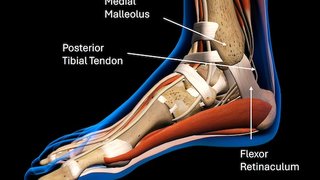
Foot and ankle conditions are any injuries or problems that affect the bones, joints, ligaments, tendons, or nerves of the feet and ankles.
These conditions can cause pain, swelling, stiffness, weakness, or difficulty walking. Foot and ankle conditions often result from overuse, trauma, deformities, or age-related changes.
What Are the Types of Foot and Ankle Conditions?
Our orthopaedic and podiatric foot and ankle surgeons treat a broad range of injuries and conditions, such as:
- Achilles tendinitis, an injury of the tendon that connects the calf muscle to the back of the heel
- Acquired flat foot deformity, a condition in which the arch of the foot falls over time
- Ankle fractures (breaks in the ankle bones)
- Arthritis of the feet and ankle
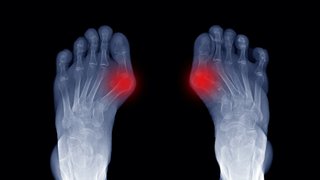
- Bunions, which are bony bumps that form at the base of the big toe
- Cartilage injuries of the ankle
- Congenital and adult deformities
- Diabetic foot problems such as ulcers, sores, bruises, cuts, infections, and Charcot foot
- Flat feet and related problems such as arch pain, plantar fasciitis, and shin splints
- Foot fractures (breaks in the foot bones)
- Hammertoes, which are toe deformities that cause one or more toes to bend downward
- Heel pain
- High arched feet/cavus foot
- Malunions (improperly healed fractures) of bones or joints
- Metatarsal pain and injuries, which involve the long bones in the middle of the foot
- Muscle and tendon problems such as tendonitis, Haglund’s deformity, and general pain
- Neuromas, thickened nerve tissue in the foot that can cause pain, burning, or tingling
- Neuropathy, when peripheral nerves are damaged, causing weakness, numbness, and pain
- Overuse injuries
- Plantar fasciitis, inflammation of the band of tissue that supports the arch of the foot
- Shin splints, which are often related to running or exercise and cause pain along the shinbone
- Stress fractures
- Tendon injuries
- Traumatic injuries
- Turf toe, a sprain of the big toe joint, usually caused by forceful upward bending
Why Choose UT Southwestern for Foot and Ankle Care?
UT Southwestern’s physicians work to provide each patient with attentive, personalized foot and ankle care to relieve the pain and mobility problems associated with foot and ankle conditions.
Our fellowship-trained surgeons are committed to providing effective, compassionate foot and ankle care. Our multidisciplinary, collaborative approach means patients can get any treatment they need within the UT Southwestern system.
Patients benefit from:
- Leading-edge diagnostic tools to help guide treatments
- Evidence-based solutions and working in partnership with patients to create individual treatment plans that best achieve the outcome the patient wants
- Our focus on conservative, nonsurgical treatments whenever possible and considering surgery only when it’s the most appropriate option
What Are the Symptoms of Foot and Ankle Conditions?
Symptoms of foot and ankle conditions include:
- Abnormally bent joints
- Corns and calluses
- Instability in the ankle or foot
- Noticeable bumps or deformities on the foot
- Persistent or intermittent pain
- Rashes or growths
- Redness or swelling of joints or tendons
- Restricted movement of the foot and ankle
- Swelling, numbness, or tingling
People who are experiencing debilitating pain or symptoms that affect their mobility should schedule an appointment with one of our experts as soon as possible.
How Are Foot and Ankle Conditions Diagnosed?
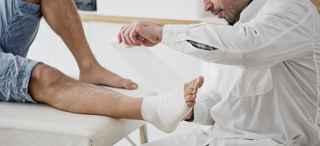
Our foot and ankle specialists can often diagnose a foot or ankle injury or condition based on a physical examination and medical history.
We might also order advanced imaging to make sure there are no fractures or to see where tissue is wearing thin, including:
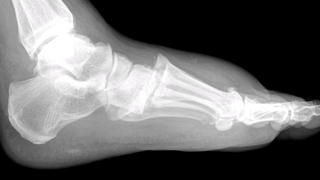
- X-rays
- MRI, which can help spot stress fractures and soft-tissue injuries, such as ligament sprains
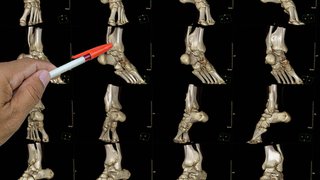
- CT scan, which offers a comprehensive view of the bones and joints
- Musculoskeletal ultrasound, which is faster than MRI or CT scans, shows movement within the joint, and can be combined with ultrasound-guided injections
How Are Foot and Ankle Conditions Treated?
Our dedicated team of physical therapists, orthotists/prosthetists, and orthopaedic and podiatric surgeons works together to create a comprehensive, evidence-based treatment plan that is individualized for each patient’s needs.
We typically start treatment by offering patients conservative approaches, such as:
- Medications or injections, such as nonsteroidal anti-inflammatory drugs or steroids
- Orthotics, boot walkers, or custom braces for functional mobilization
- Physical therapy to restore function, strength, and movement
- PRP injections, in which a small amount of blood is drawn and spun in a centrifuge to separate the platelets; the platelets are then injected into the foot or ankle to speed healing
- Shockwave therapy, or extracorporeal pulse activation therapy (EPAT), which uses pressure waves to stimulate blood flow and help promote healing
Surgery for Foot and Ankle Conditions
For some patients, conservative measures don’t provide enough relief, and surgery may be the best option to ease pain and restore function. Our foot and ankle surgeons offer the latest in reconstructive techniques, such as minimally invasive or arthroscopic surgery, open surgery, and realignment surgery for ankle and foot deformities.
Minimally Invasive Techniques
When surgery is needed, we use the least-invasive technique possible. Minimally invasive or arthroscopic surgery, such as a bunionectomy or ankle or subtalar joint surgery, has less discomfort and scarring and a shorter recovery time, getting patients back on their feet more quickly. Unlike UT Southwestern, not all foot and ankle doctors in North Texas offer minimally invasive surgery.
Minimally invasive surgery requires small incisions and a tiny camera to be inserted into the surgical site to guide surgeons through the procedure. Small surgical instruments are then inserted through the incision to perform the surgery.
We also offer minimally invasive, ultrasound-guided treatment for chronic tendon pain (tendinopathy), plantar fasciitis (fasciopathies), and soft-tissue damage.
Open Surgery
In some cases, open surgery is required. With advancements in open surgery techniques and technology, incisions are smaller than ever, making recovery time shorter. Our foot and ankle surgeons are highly trained in reconstruction and complex foot and ankle surgery.
Our experienced surgeons are experts in total ankle replacement and total toe replacement procedures, which use customized, 3D-printed models and components to help patients achieve their mobility goals.
After surgery, our physical therapists help patients regain strength and mobility.
What Support Services for Foot and Ankle Conditions Does UT Southwestern Offer?

UT Southwestern has a wide range of support services available to patients receiving either nonsurgical or surgical care for foot and ankle problems. The services include:
- Physical therapy and rehabilitation programs
- Pain management
- Education to aid recovery and long-term foot health
What Clinical Trials Are Available for Foot and Ankle Conditions?
UT Southwestern participates in research studies designed to improve care for people with foot and ankle problems. Some patients may be eligible to take part in clinical trials that explore new treatments or approaches.
Ask our doctors about current studies or search for clinical trials.
Related Conditions and Treatments


We’re one of the world’s top academic medical centers, with a unique legacy of innovation in patient care and scientific discovery.

MedBlog



Results: 4 Locations
Orthopaedic Surgery
at UT Southwestern Medical Center at Park Cities 8611 Hillcrest Road, 2nd Floor, Suite 250Dallas, Texas 75225 214-692-3490 Directions to Orthopaedic Surgery at UT Southwestern Medical Center at Park Cities, Dallas Parking Info for Orthopaedic Surgery
Orthopaedic Surgery Clinic
at Outpatient Building 1801 Inwood Road, 1st FloorDallas, Texas 75235 214-645-3300 Directions to Orthopaedic Surgery Clinic at Outpatient Building, Dallas Parking Info for Orthopaedic Surgery Clinic
Orthopaedic and Sports Medicine Programs
at UT Southwestern Medical Center at Richardson/Plano 3030 Waterview Parkway, 1st FloorRichardson, Texas 75080 972-669-7179 Directions to Orthopaedic and Sports Medicine Programs at UT Southwestern Medical Center at Richardson/Plano, Richardson
Orthopaedic, Sports Medicine, and Rehabilitation Programs
at UT Southwestern Medical Center at Las Colinas 6121 N. State Highway 161, 3rd Floor, Suite 300Irving, Texas 75038 469-647-4704 Directions to Orthopaedic, Sports Medicine, and Rehabilitation Programs at UT Southwestern Medical Center at Las Colinas, Irving